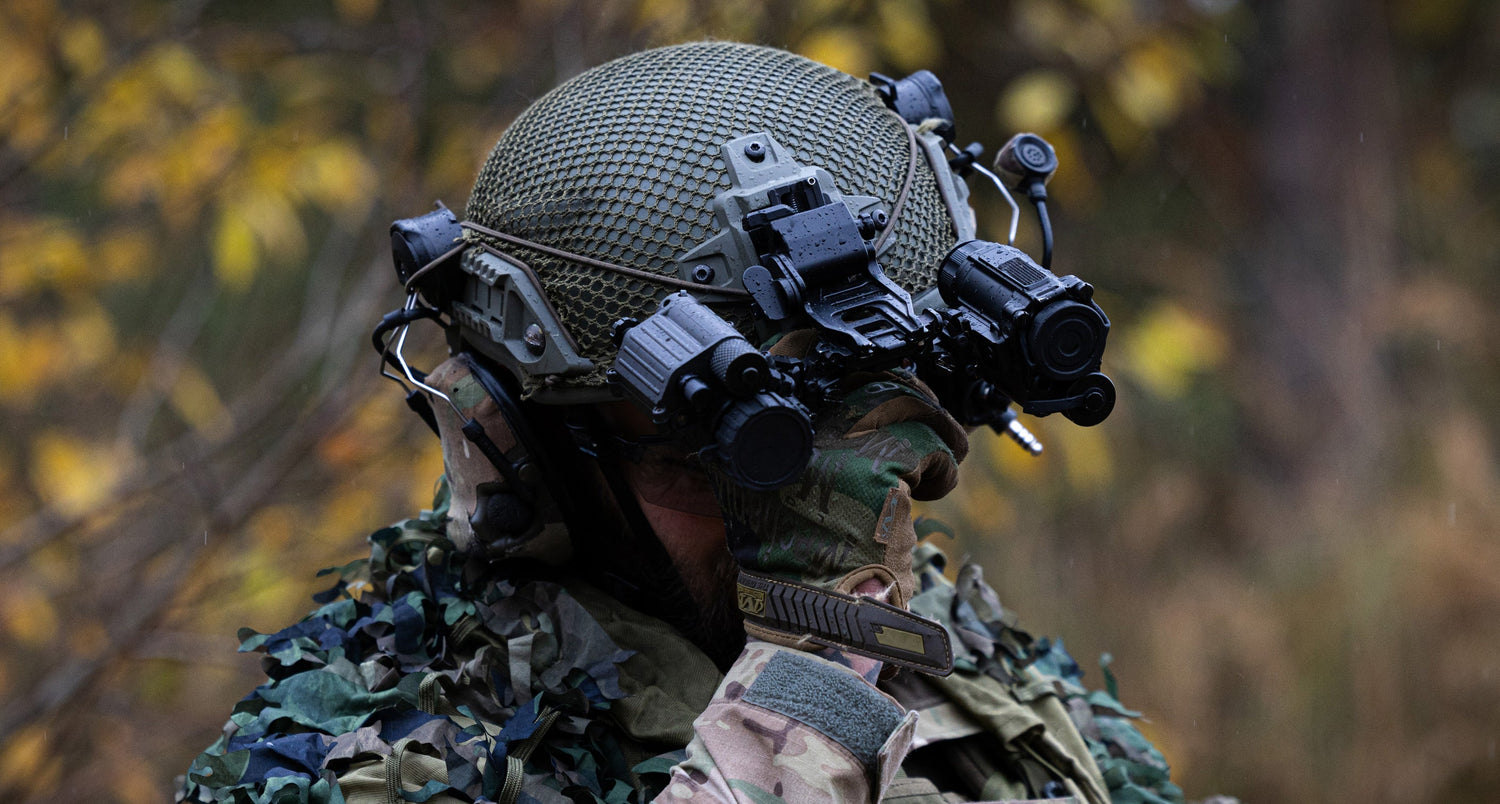
To run a thermal monocular on a helmet you need a chain of four parts: a shroud on the helmet, a helmet mount that clicks into the shroud, a device adapter that matches your specific thermal, and the thermal itself. Most mounting problems we see in support are one wrong link in that chain, usually the adapter. This guide walks the chain from helmet to device so you can check yours link by link.
Start at the helmet: shroud and mount
Almost every modern helmet ships with a three-hole shroud up front. Into that goes the helmet mount, and this is where most of the quality difference lives. A real customer message we got sums up the upgrade path: "atm I have a rhino mount on my helmet, the LMNVM A4 is compatible for the same helmet mount right?"
The classic Rhino mount works, but it's decades-old military surplus design: heavy, tall, and famous for play in the joints. We made a whole video about why that matters, because the wobble isn't cosmetic. As we said there: "This wobble here ruins your whole user experience. You can't run, you can't shoot." A wobbling image at 1x magnification, centimetres from your eye, is fatiguing in a way no spec sheet shows.
What we actually recommend and run ourselves is the UDAPT F25 low-profile mount. If you want the premium option with a breakaway function, the Wilcox G24 is the other dovetail mount we stock. The A4 LWNVM is another popular choice that interfaces with the same standard shroud. And if you're stuck with an old-style PVS-14 J-arm setup, our PVS-14 Mounting Upgrade Kit replaces exactly the parts that cause the play.

The link people get wrong: the device adapter
Thermals don't have a standard mounting interface the way a PVS-14 has its J-arm socket. Each model needs its own adapter to end up on a dovetail. That's the whole point of our QD ecosystem: one adapter per device, and then everything clicks into the same mounts.
| Your device | Adapter you need |
|---|---|
| Jerry-YM / Jerry-YM 2.0 | QDA (J-YM) |
| Falcon 640+ V2 (RH25 family) | QDA (Falcon 640+ V2) |
| PVS-14 / THE-14 night vision | QDA (PVS-14/THE-14) or the Dovetail J-Arm |
| MUM-14 | QDA (MUM-14) |
| Skeet IR | QDA (Skeet IR) |
| Anything with a mini rail | QDA (Minirail) |
Once your device wears its QDA, it stops being a special case. It clicks into the QDM for single helmet use, pairs with a second device on the QDB bridge for the night-vision-plus-thermal setup, or drops onto the QDF flip-to-side weapon mount. Swapping a thermal from helmet to rifle between games takes seconds, not tools. The full range of adapters lives in the NVG mounts collection.
One hard rule while we're here: never put a night vision tube on the QDF or any weapon mount. Tubes don't tolerate recoil. The QDF is for thermals. This rule has no exceptions and yes, we will repeat it every time.
Common questions from the support inbox
Will a thermal work on my existing Rhino/dovetail mount?
If your mount has a standard dovetail interface, yes, as long as the thermal wears the right QDA. If it's an old bayonet-style Rhino, you'll need a dovetail mount or an adapter first. When in doubt, send us a photo of your current mount before ordering.
Can I run night vision on one side and thermal on the other?
That's exactly what the QDB bridge is for, and it's our favourite setup: tube over one eye for movement, thermal over the other for detection. See the Falconclaw Ecosystem video for what that looks like in the field, including finding a person lying at a tree line 200-300 metres out who was invisible on the tube.
The device sits too low / too close to my eye. Is that normal?
Height and eye relief come from the helmet mount, not the device. This is the main reason we push people towards adjustable modern mounts. One customer put it well: his devices sat "a bit too close to the eyes" on an old converted mount, which no adapter can fix. That adjustment range is what you're paying for in mounts like the F25 and G24.
Is helmet-mounting heavy?
Less than you'd think if the parts are modern. Our QD ecosystem parts are machined from 7000-series aluminium and the mounts themselves are lighter than the surplus steel classics they replace. Add a counterweight pouch on the back of the helmet and a monocular setup carries comfortably for a full night.
Check the chain, then buy
Shroud, mount, adapter, device. Spend properly on the mount, buy the one adapter that matches your exact device, and the rest of the system takes care of itself. Still unsure? Name your helmet, mount and device in the chat and we'll confirm the missing pieces. The wrong adapter is just money sitting on a shelf.

Leave a comment
This site is protected by hCaptcha and the hCaptcha Privacy Policy and Terms of Service apply.