
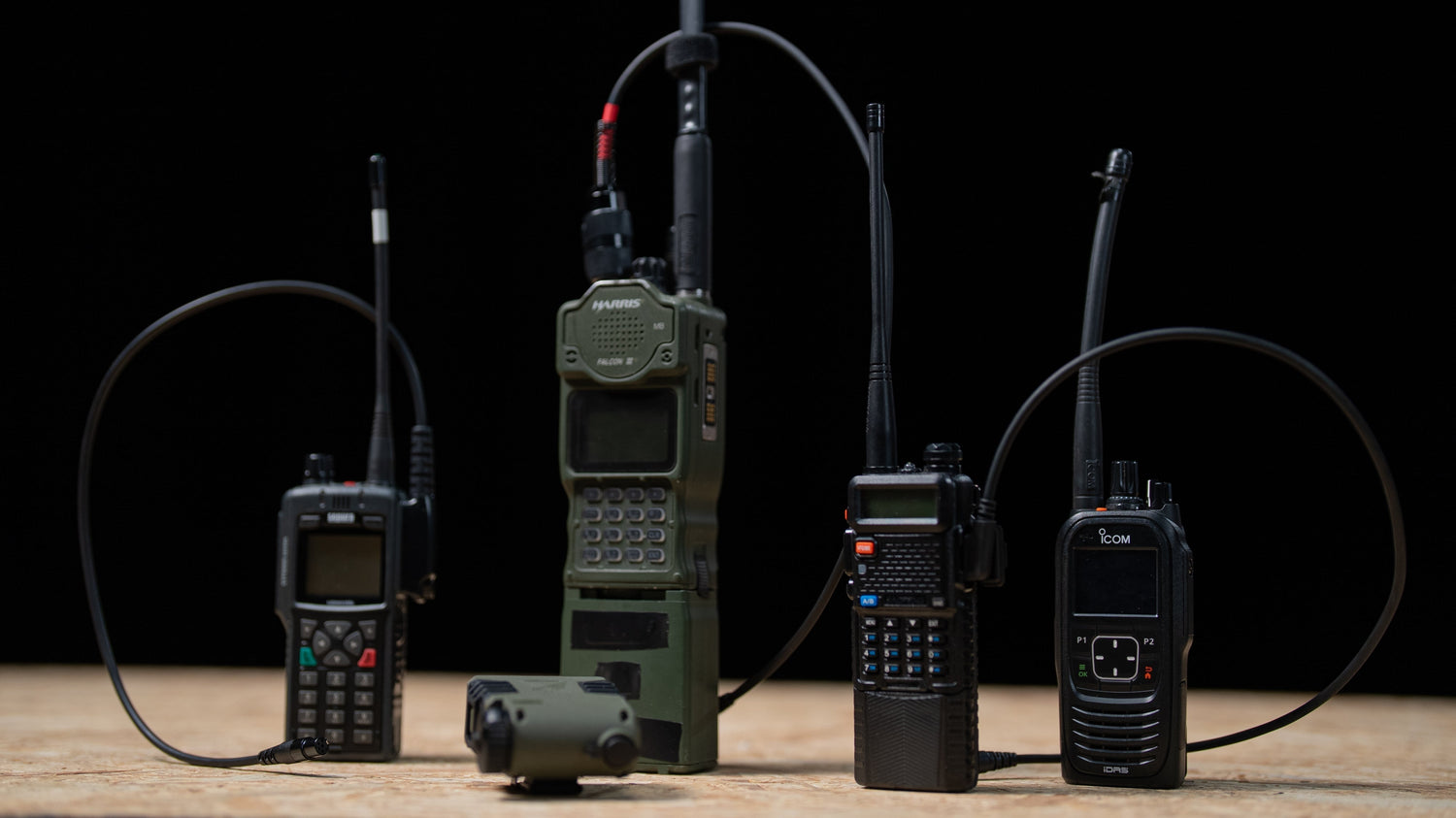
The FC PTT ships without a radio cable, and that's deliberate: one PTT body, swappable downleads, so you buy exactly the cable your radio needs and nothing else. The catch is that "my radio has two pins" is not enough information. Kenwood two-pin, Motorola two-pin and ICOM two-pin all look like close cousins and none of them fit each other. This guide sorts radios into connector families so you order the right cable the first time.
A real question from our inbox shows how tangled this gets: "I need a U94 PTT for Sordin NATO U-174/TP-120 headset. Which radio connector should I choose for Motorola DP4400? Also, is the same cable compatible with Motorola R7, or do I need a separate R7-specific cable?" Three compatibility questions in one message, and all three are about connectors, not brands. So: connectors.
The rule that prevents 90% of wrong orders
Match the physical connector family, not the manufacturer. The same brand uses different connectors across product lines (Motorola alone has used several over the years), and different brands share the same connector (Baofeng, Retevis, TYT and Wouxun all take the Kenwood plug). Looking similar means nothing; plenty of connectors in this world look nearly identical and specifically do not fit each other, either mechanically or in wiring.
The cable families we stock
| Cable | Fits (connector family) |
|---|---|
| Kenwood plug | Baofeng UV-5R/UV-82, Retevis, TYT, Wouxun, Kenwood TK series |
| 2-pin Motorola | Motorola CP040, GP300, CP / XT / XTN series |
| Motorola GP340 | Motorola GP / HT / MTX / PRO series: GP340/380, HT750/1250/1550, MTX850 |
| 2-pin ICOM | ICOM IC-F, IC-H, IC-M, IC-J, IC-U series, plus Cobra and Ritron |
| 6-pin NATO | AN/PRC-152, AN/PRC-148 MBITR, Harris, TRI, TCA, FCS, Thales replicas |
| 9-pin Fischer | Harris RF-7800S (the "SPR"), RF-7850S |
| Sepura | Sepura STP series, 4-pin |
All downleads are 50 cm; if your radio rides on the back of a plate carrier, add the extension cable. Live stock and current prices are on the PTT Cables & Compatibility page, which also has a search box covering 1,200+ radio models by name and nickname. Typing "SPR" there finds the Fischer cable; that's the fastest route if your radio isn't obvious in the table above.

The headset side
The cable question has a twin on the other end of the PTT: what your headset plugs into. The PTT comes wired for either NATO or Peltor standard headset connectors, and for everything else there are adapters: a 3.5 mm AUX adapter for comms-ready hearing protection like Sordin and Howard Leight, and a Peltor 2-pin adapter for SportTac/ProTac-style ear pro. Running a primary and a backup radio into one headset is what the Dual Comm adapter is for. All of it lives in the PTTs & Adapters collection.
No cable exists for your radio? Build your own: the FC-PTT pinout
We get requests for genuinely rare radios, and some of them will never sell enough to justify a production cable. That doesn't lock you out of the PTT. The bottom connector of the FC-PTT is a standard 6-pin mini XLR, and if you can hold a soldering iron, you can make your own downlead. Here is the full pinout, straight from our engineer, published so you don't have to email us for it.

The connector routes four signal groups between the PTT unit and the radio: PTT activation, speaker audio, microphone audio, and ground. In text form, for anyone searching for the FC-PTT mini XLR pinout:
- Pin 1: PTT1 (transmit activation)
- Pin 2: SPK + (speaker audio, positive)
- Pin 3: SPK − (speaker audio, negative)
- Pin 4: GND (ground)
- Pin 5: MIC + (microphone audio, positive)
- Pin 6: EMPTY. Currently not active, reserved for future dual-PTT / PTT2 support.
Building the cable takes three ingredients: a 6-pin mini XLR male connector for the PTT end (pin numbers are marked on the connector itself), the correct plug for your radio's accessory socket, and your radio's own pinout, which lives in its service manual or on radio forums. Then you map signal to signal: your radio's PTT line to pin 1, speaker pair to pins 2 and 3, ground to pin 4, mic to pin 5. One warning from experience: the mapping is not always one wire to one wire, because many radios key transmit by pulling the mic line to ground instead of using a dedicated PTT wire. Working out that logic for your specific radio is exactly the kind of puzzle an AI assistant solves well; paste in this pinout and your radio's pinout and ask it for the wiring plan, then verify every connection with a multimeter before you key up for the first time. A miswired cable can feed speaker voltage into something expecting a microphone, and that's how audio stages die, so a self-made cable is strictly a build-at-your-own-risk project.
If your radio is popular and we just don't stock the cable yet, still tell us in the chat before reaching for the soldering iron; enough requests for the same model is exactly what gets a cable added to the line-up.
Asked constantly
My radio isn't in the table. Now what?
Use the model search on the cables page first; it knows far more models than this post lists. If it's genuinely not there, ping us in the chat. New cables get made based on which radios people actually request, so asking literally influences what we build next. And for truly exotic radios, the pinout section above lets you build a working downlead yourself.
My old Baofeng cable physically fits my new radio. Safe to use?
Fitting into the socket is not the same as being wired for it. A mechanically-similar plug with different wiring gives you symptoms people blame on the PTT: one-way audio, stuck transmit, no mic. If the radio model isn't listed for that cable family, check before keying up.
Does the PTT work for amateur radio use?
Yes. Plenty of PTT units go out to licensed hams running Baofengs and other Kenwood-plug handhelds. Same PTT, same logic: find your connector family, pick that downlead.
What's the warranty on the PTT?
Two years, longer than our standard 12 months, and it's designed and made in Estonia. We're confident in the unit; the usual failure mode in the field is a mismatched or damaged cable, which is exactly why this guide exists.
Before you order
Thirty seconds of checking saves a return: find your radio's exact model designation (it's usually under the battery), run it through the search on the cables page, and if two families look plausible, message us with the model and a photo of the connector. We answer these daily and would rather confirm twice than have you standing at the field with a cable that almost fits.

Leave a comment
This site is protected by hCaptcha and the hCaptcha Privacy Policy and Terms of Service apply.