
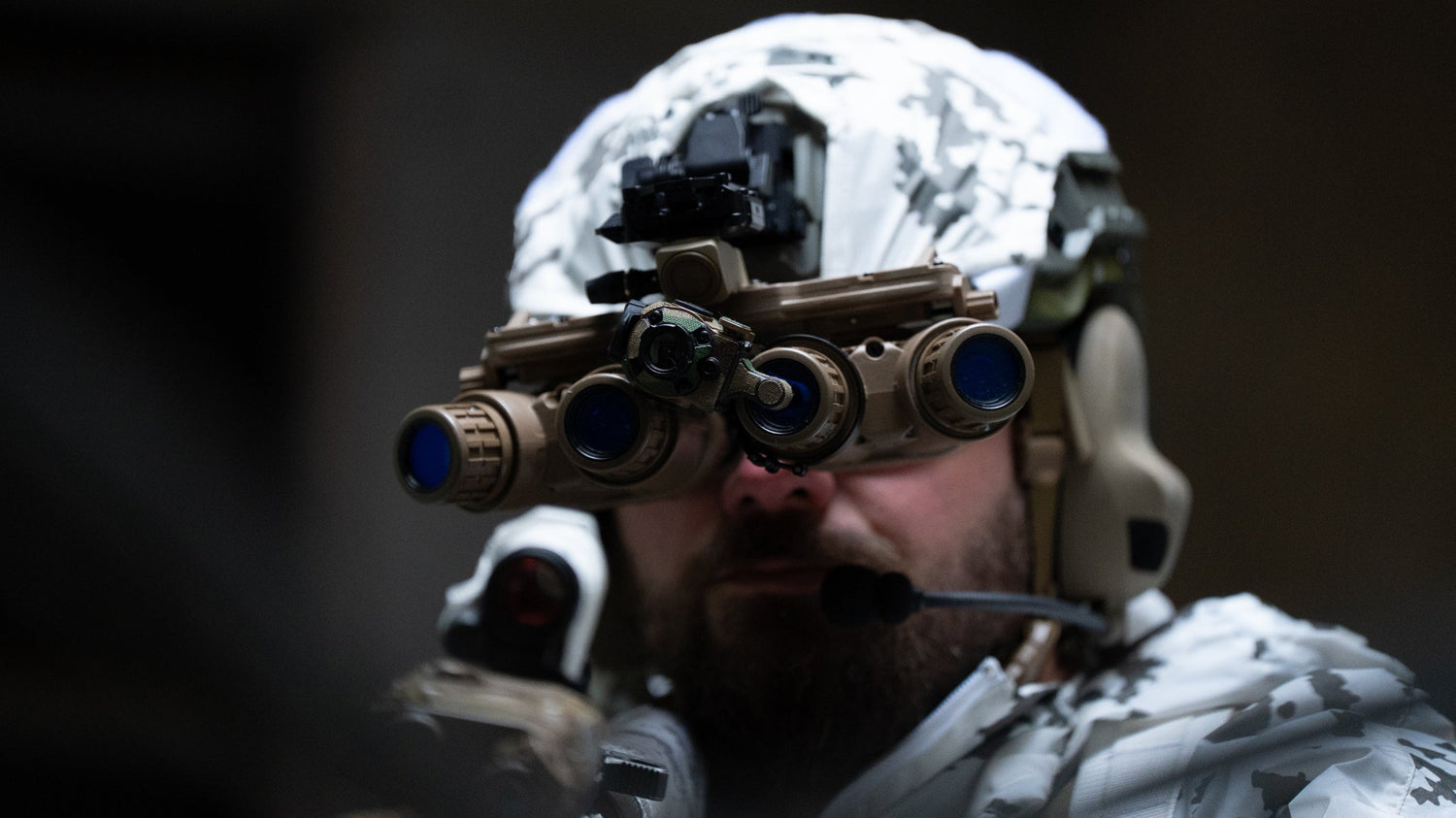
A thermal overlay, often called a COTI (clip-on thermal imager), is a small thermal camera that attaches in front of your night vision device and projects heat signatures directly into the tube. You keep looking through your normal night vision image; the overlay paints a glowing outline over anything warm. One device on your face, two technologies working at once. Our version is the FTO 640, and this post explains what an overlay genuinely does, where it falls short of a dedicated thermal, and who should buy which.
The problem it solves
Night vision has a blind spot that surprises new owners: dark pockets inside an otherwise visible scene. A shadow under a tree line, an unlit room, the far end of a corridor. Your tube needs at least some light to amplify, and those spots have none. We call it the dark room paradox: you can fix it with an IR illuminator, but an IR beam is a flashlight to every other night vision user in the area, so you announce yourself to solve it.
An overlay solves it passively. In our FTO 640 review we walk through exactly these situations, finding people tucked into dark spots that the tube alone could not penetrate: under trees, inside unlit rooms, behind what we call photonic barriers, where a bright light between you and the target washes out everything behind it. The thermal outline doesn't care. Warm object, glowing mark, done.


Same dark spot, overlay on and overlay off.
Smoke is the same story. We tested CQB smoke indoors and night vision went blind while the overlay kept showing the person's location, down to what he was holding. That's not a party trick; it's a different physical sensing channel riding on top of your tube.
What it costs you: the honest trade-off
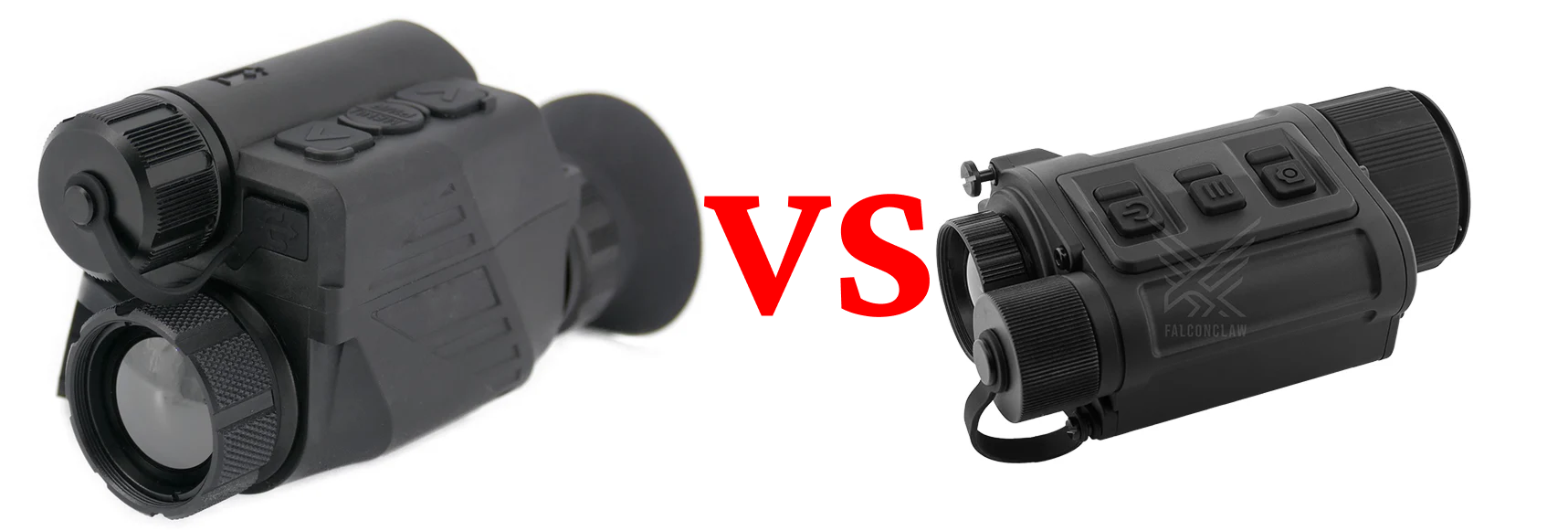
An overlay is not a compressed dedicated thermal. It's a detection aid. The practical numbers from our field testing: an overlay setup spots people at roughly 300 to 600 metres depending on the backdrop, while a proper dedicated thermal reaches 1.5 to 2 kilometres. From our dual-band versus clip-on comparison: "The dedicated thermal, you can be on an OP... and you can detect heat 1.5 to 2 kilometers away." The overlay also only works at night, because it needs your night vision underneath it, while a dedicated thermal is a day-and-night tool.
In exchange, the overlay wins on simplicity. There's no second image for your brain to manage, no bridge hardware, and the current FTO generation weighs 62 grams, which your neck will not notice. It runs a 35-degree field of view, a focusable lens, power-saving modes, and up to 10 hours with the battery-pack option. Details and current price are on the product page.
So overlay or dedicated thermal?
The decision reduces to one question: do you already own good night vision?
If yes, the overlay is the single best upgrade available to you. Your existing tube gains a detection channel and you stay light, simple, and passive. If no, buy a dedicated thermal first (our buying-order guide explains why thermal comes before night vision), because an overlay without a tube under it is a paperweight. And if you're a range-obsessed user who wants maximum detection distance, a dedicated unit like the Falcon 640+ V2 bridged next to your tube beats an overlay; that's the dual-band setup from our mounting guide.

Things people ask before buying one
Does the FTO work on my monocular / binocular?
It mounts on the PVS-14-style lens interface, so it fits PVS-14 monoculars and binoculars like the DTNVS and the FC-B directly. PVS-31 and panoramic housings need a special bracket. If you run something unusual, message us with the model before ordering and we'll confirm the attachment.
Is the overlay image the same as looking through a thermal?
No, and it's not trying to be. You get a highlight, an outline of the warm object, layered over your normal night vision picture. Identification detail still comes from your tube; the overlay just tells you where to look.
Can I zero a rifle with it?
Wrong tool. The overlay lives on your head, on your night vision. For weapon use you want a clip-on thermal on the rifle itself, which we cover separately, and remember tubes never go on guns at all.
What does it do in daytime?
Nothing useful. It projects into a night vision tube, and tubes stay stored in daylight. A dedicated thermal is the tool that crosses into daytime use.
Who should skip it
Skip the overlay if you don't own night vision yet, if your typical detection distances run past several hundred metres, or if you want one thermal that also works handheld in daylight. That money belongs in a dedicated unit. But if a tube already lives on your helmet and you've ever swept a dark tree line knowing something could be standing in it, the overlay is the difference between suspecting and seeing.

Leave a comment
This site is protected by hCaptcha and the hCaptcha Privacy Policy and Terms of Service apply.